


Midsummer Legends and Traditions: A Seasonal Guide for Storytellers
EXCERPT: British Midsummer folklore — hilltop fires, herb gathering, fairy lore and love divination — with practical ways for storytellers to weave these traditions into new tales.
Midsummer is not a single day so much as a seam in the calendar. In Britain it gathers around St John's Eve on 23 June and Midsummer Day on 24 June, the feast of St John the Baptist — a festival grafted so neatly onto far older midsummer customs that the two can no longer be pulled apart. The sun stands still at the top of the year; in the north the sky never quite goes dark. That half-light is the point. It is a season of thresholds, when the ordinary rules of the world are said to loosen, and that is exactly what makes it such generous ground for storytellers.
First, the Difference Between Beltane and Midsummer
This matters more than it sounds, because storytellers mix the two up constantly. Beltane belongs to May Eve and the first of summer: cattle driven between fires, May poles, the beginning of the growing year. Midsummer belongs to late June, when the year has already turned green and begun to hold its breath. The fires are still there, but the mood is different — less about starting something than about protecting it, and about what comes out when the nights are shortest.
Both are liminal, and both are old, but a story set at Midsummer should feel different from one set at Beltane. Midsummer is the peak, not the threshold of arrival. Everything is at its strongest: the herbs, the sun, the light, and the fair folk.
Hilltop Fires: Midsummer Eve Bonfires
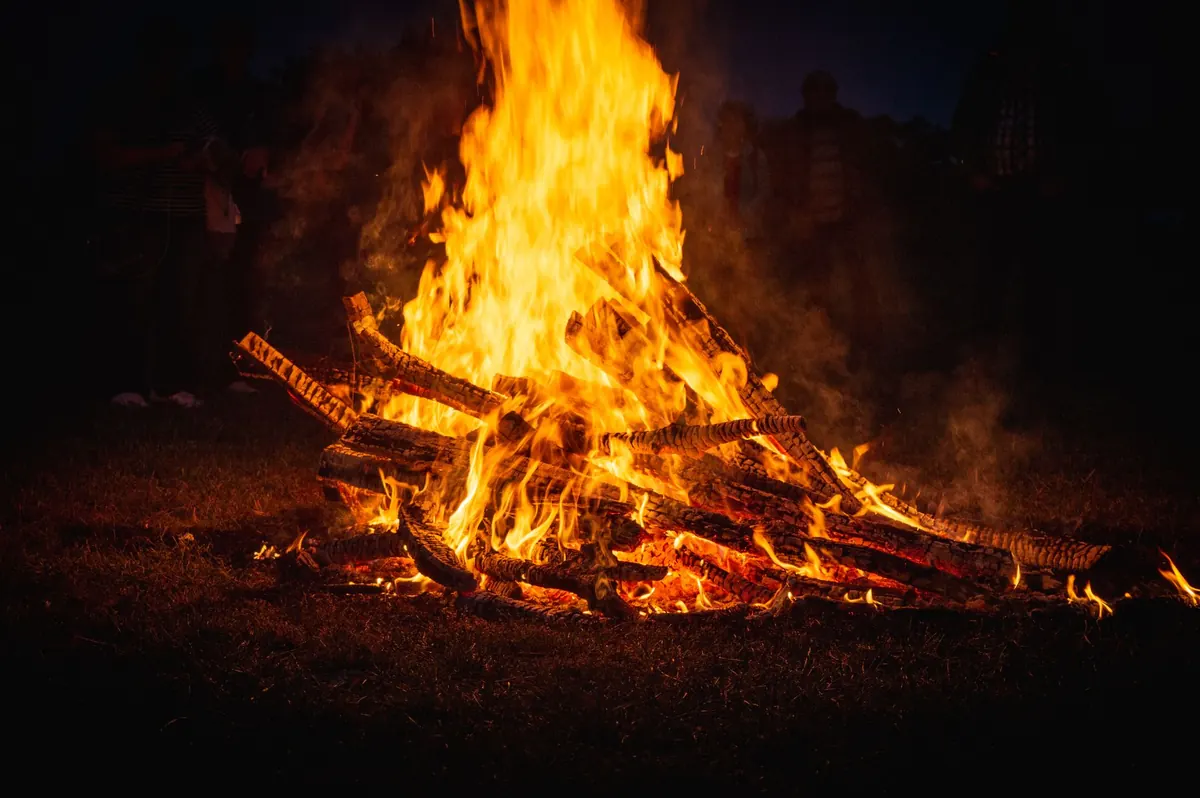
The defining image of British Midsummer is a chain of fires strung along the ridges, lit at dusk on 23 June and answered hill to hill. Cornwall keeps the tradition most visibly, with the Old Cornwall Societies lighting a series of hilltop bonfires on Midsummer Eve, and the Golowan festival in Penzance reviving the old town celebrations. In parts of Devon, a blazing tar barrel or a wheel packed with straw was rolled down a hillside — a sun-wheel sent spinning towards the valley.
What the Fires Were For
- Protection: fire was carried around fields and byres, or ashes scattered on the land, to keep blight, sickness and ill luck at bay for the coming year.
- Blessing the herd: in Ireland and the Highlands, cattle were driven through the smoke or between two fires, a practice with older roots than anyone can now trace.
- Divination: couples leapt the flames together — a high jump meant a good year, a clumsy one meant a quarrel, and a hand that let go was an omen nobody wanted.
- Community: the bonfire was a boundary marker as much as a celebration, a way of saying this is who we are and where we stop.
For a storyteller, the great gift of the bonfire is that it gives you an audience. Everyone in the village is gathered in one place, at night, looking the same way. Put a stranger at the edge of that light and you have a story already half built.
Herb Gathering: The Magic of the Green World
Midsummer Eve was the great herb-gathering night. Plants cut then were believed to carry their virtue at full strength — stronger medicine, stronger magic — and they were often gathered in silence, before sunrise, with a prayer or a rhyme. Some were left as offerings rather than taken.
- St John's wort — the defining Midsummer plant, also called chase-devil. Hung over doorways to keep out harm, and slipped under a pillow for dreams of a future lover.
- Orpine, or Midsummer Men — two cuttings set upright in pairs. If they leaned towards each other by morning, the match was true; if one withered, the answer was no.
- Mugwort — placed in a shoe or carried on a journey for protection and tireless feet.
- Vervain — sacred, rare, and said to require a careful hand to pick at all.
- Yarrow — a divining herb with a rhyme of its own, used to discover who a girl would marry.
- Elder — the "Mother Elder", respected and half-feared, never cut carelessly.
I know a bank where the wild thyme blows, / Where oxlips and the nodding violet grows, / Quite over-canopied with luscious woodbine, / With sweet musk-roses and with eglantine. — William Shakespeare, A Midsummer Night's Dream
Fairy Lore: When the Veil Grows Thin
Midsummer Eve is the night the fair folk are abroad. Not the winged, thumb-sized creatures of Victorian illustration, but the older, colder kind: the Good People, the Fair Folk, the Others — named with euphemism because naming them plainly was thought to invite attention. They dance in rings, ride out in companies, take people away and sometimes return them with no memory of the years that passed. Tam Lin, rescued from the fairy court by Janet, is the great Scottish telling; Thomas the Rhymer is another.
The Rules of a Fairy Encounter
- Do not eat or drink anything offered to you. That is the oldest and most reliable prohibition in the tradition.
- Do not thank them too freely — thanks can bind as tightly as a bargain.
- Do not step inside the ring. Dancing in it costs a year or a lifetime, depending on the teller.
- Carry your defence: iron, salt, a rowan cross, a coat turned inside out, or a sprig of St John's wort.
- Expect a price. Fairy gifts, fairy aid and fairy love always come with a debt attached, named or not.
Love Divination: Midsummer Night's Games
Because Midsummer was a night of thinning boundaries, it was also a night for finding out who you would marry. The rituals were domestic, cheap and often faintly dangerous, and they were usually performed by young women in company, in silence, and with more than a little courage.
- Midsummer Men — orpine cuttings set in pairs to lean together or apart by morning.
- The dumb cake — a cake made in silence by a group, each person eating a piece and walking backwards to bed, hoping to dream of a future spouse.
- Sowing hemp seed at midnight, reciting the rhyme and watching who appeared to mow.
- Gazing into a well or a mirror at midnight to catch a face.
- Placing St John's wort or yarrow under the pillow for a revealing dream.
Hemp seed I sow, hemp seed I grow; he that is my true love, come after me and mow.
A Storyteller's Midsummer Calendar
If you are building a tale around the season, anchor it to real dates and real chores:
- 22–23 June: gathering herbs, building the bonfire, the vigil that ends in divination.
- 23 June, dusk: the fires are lit, the hilltops answer each other, and the night's rules are suspended.
- 24 June: the morning after — the ashes, the promises made, the person who did not come home.
- The following weeks: consequences. Midsummer bargains are traditionally paid in autumn, or seven years later.
Practical Notes: Building a Midsummer Story
Four Things That Make It Work
- Tether the supernatural to a real task. Herb gathering, tending a fire and watching cattle are all ordinary work. Magic that interrupts ordinary work feels far more convincing than magic that arrives out of an empty sky.
- Use the light. Midsummer's dusk never quite settles. That grey, charged half-dark does more for atmosphere than any amount of description.
- Keep the fairies morally ambiguous. They are not villains and they are not helpers. They are people with their own business, and your protagonist is standing in it.
- Give the bargain a price. The strongest traditional tales end with a debt. Name it, and let the listener work out what it will cost.
Common Pitfalls
- Conflating Beltane and Midsummer — a small error that will be noticed by anyone who knows the calendar.
- Going twee. Victorian prettiness drained the teeth from these stories. The older material is stranger and less kind.
- Explaining too much. Traditional tellings leave the fair folk unexplained. So should you.
- Forgetting the community. Midsummer is a communal festival. A story with only one character on the hill loses half its texture.
Midsummer endures as storytelling material because it is about a question everyone recognises: what happens when the rules relax for one night, and what do we owe for it afterwards? Light the fire, gather the herbs, name the price — and let the longest day do the rest.
Photo: Péter Borkó / Pexels
Related posts
More stories you’ll love reading